


In a world where LinkedIn endorsements and referral emails open doors, reputation is literal currency. Jay Walmsley’s Reputation Loop—Learning, Teaching, Resource Utilization, Community Building, Connection, Reputation—becomes a practical roadmap I use daily. I learn via Harvard Business Review and Coursera, teach through webinars on Zoom, leverage HubSpot and Notion for resource sharing, cultivate community on Slack and LinkedIn, and track introductions in Google Contacts. I measure impact with HubSpot reports and LinkedIn analytics, turning ad hoc networking into a repeatable system that earns trust, referrals, and business momentum.
Did You Know?
In Jay Walmsley’s insightful book, “Network- Educate- Invite,” he presents a transformative framework called The Reputation Loop, which emphasizes the importance of reputation as a currency in both personal and professional spheres. From my exploration of this text, I’ve come to understand that my reputation is crafted through every lesson I learn, the help I provide to others, the words I share, and the connections I nurture. Walmsley breaks down the path to earning trust into a series of interlinked steps: Learning, Teaching, Resource Utilization, Community Building, Connection, and Reputation. The journey begins with the commitment to lifelong learning. Walmsley argues that true expertise arises not from diplomas but rather from a continuous quest for knowledge and understanding. This learning process empowers me to adapt to rapidly changing markets and technologies, affording me the ability to seize new opportunities. In today's world, continuous learning breeds not only expertise but also confidence, allowing me to communicate my insights effectively and authentically. Confidence derived from hard-earned knowledge is magnetic; it signals credibility without the need for loud self-promotion. Teaching emerges as another vital step in solidifying my reputation. Through teaching, I deepen my understanding while establishing myself as an authority. Each act of sharing knowledge, whether through social media posts, webinars, or casual conversations, reinforces my role in the community and helps cultivate a culture of learning. Walmsley emphasizes that sharing wisdom multiplies impact, enabling me to foster connections and lead by example. By promoting a learning culture within my business and beyond, I not only enhance my credibility but also support the growth of those around me. Throughout the text, Walmsley underscores the value of curiosity as a driving force for innovation and competitive advantage. As I remain curious and ask essential questions, I discover insights that further refine my expertise and resonate with my audience. The cultivation of a community is another integral element; my engagement turns passive audiences into active participants who help foster an environment of continuous learning and collaboration. With a proactive focus on networking, I learn that every introduction I make enhances community ties and builds reputation currency. By embracing the role of a super-connector—facilitating connections and supporting others—I position myself as a valuable asset within my network. The psychology behind connection strengthens my influence and underscores the need to prioritize these interactions, leading to rewarding partnerships and recommendations. As I reflect on the importance of reputation, it becomes clear that visibility, resources, community, and genuine connections are the cornerstones of my professional identity. Each layer contributes to a reputation that communicates reliability and trustworthiness. In today’s market, the way I am perceived can overshadow the quality of my services; thus, I am committed to fostering a reputation that resonates with integrity. By implementing robust systems for managing my networking efforts—such as CRM tools, organized content calendars, and consistent engagement strategies—I establish a sustainable foundation for my reputation. These systems ensure that I can scale my influence without sacrificing authenticity or becoming overwhelmed. Finally, I am reminded that my reputation is my most valuable asset and should be nurtured carefully. The principles of service guide my actions, ensuring that each interaction leaves a lasting, positive impression. The end goal is to cultivate an enduring legacy where my contributions empower others, thus embedding my name with a sense of trust and quality. As I embark on this journey of growth, I carry forward the understanding that sustaining my influence demands a delicate balance of learning, teaching, connecting, and renewing my commitment to community. By doing so, I secure my position as a trusted figure, where my story, experiences, and contributions can inspire others to thrive alongside me. My name, ultimately, will reflect a commitment to integrity and impact, ensuring that my legacy extends far beyond my individual endeavors.
Source: Jay Walmsley, Network- Educate- Invite
The Reputation Loop Unpacked
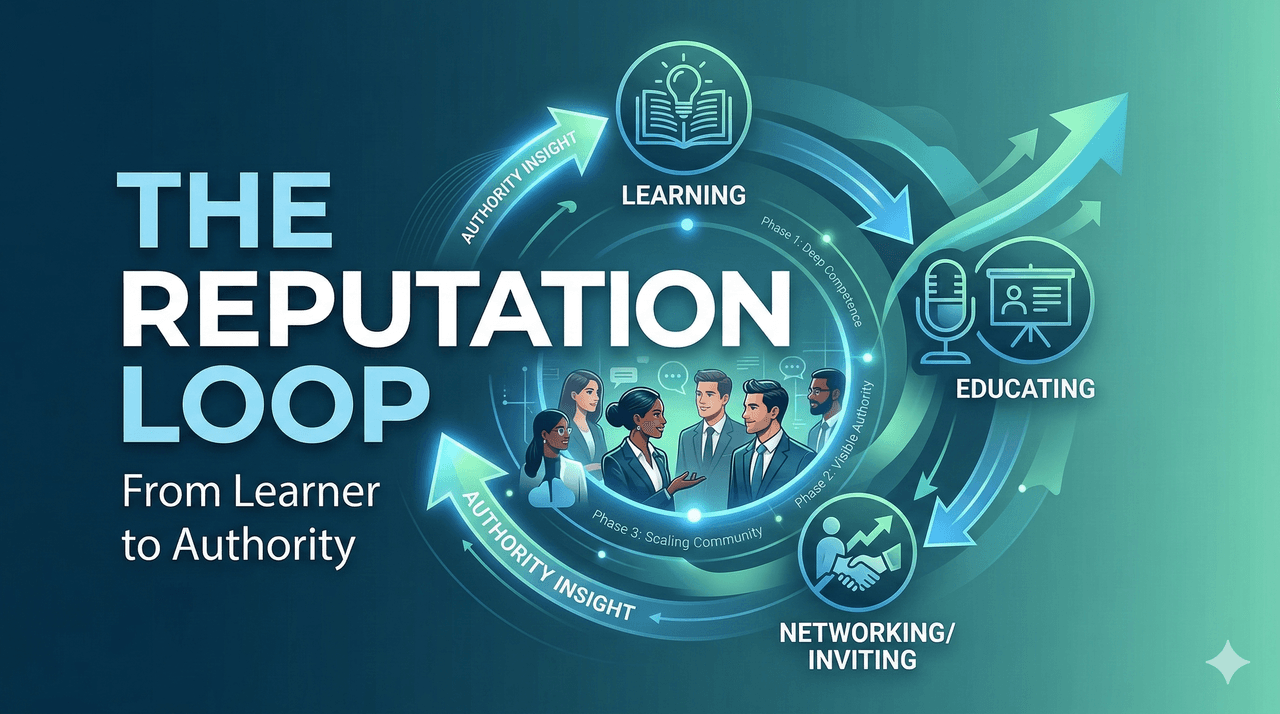
In Jay Walmsley’s insightful book, “Network- Educate- Invite,” he presents a transformative framework called The Reputation Loop, which emphasizes the importance of reputation as a currency in both personal and professional spheres. From my exploration of this text, I’ve come to understand that my reputation is crafted through every lesson I learn, the help I provide to others, the words I share, and the connections I nurture. Walmsley breaks down the path to earning trust into a series of interlinked steps: Learning, Teaching, Resource Utilization, Community Building, Connection, and Reputation.
The six steps map to action: Learning sharpens skill, Teaching multiplies knowledge, Resource Utilization leverages tools like HubSpot CRM and Notion, Community Building creates reciprocity, Connection activates introductions, and Reputation converts goodwill into referrals.
Reputation functions as currency because consistent small acts—timely replies, useful content, referrals—compound into credibility. Using systems like Calendly and Zapier preserves consistency, making micro-actions scale into lasting trust.
Learning as the Foundation: Lifelong Growth
Jay Walmsley insists expertise comes from persistent curiosity, not credentials. I prioritize continual study—reading Jay’s "Network‑ Educate‑ Invite", taking Coursera specializations, and subscribing to Substack essays—to keep ideas fresh and reputations current.
Curiosity fuels innovation and adaptability; asking better questions led me to pivot products and explore AI workflows. Confidence grows when knowledge is earned, which makes honest communication persuasive without hype.
How I stay current
Reading: Pocket and Feedly queues curated daily.
Courses: Coursera, edX, and community workshops for targeted skills.
Mentorship: Monthly calls with mentors and peer study groups in Notion databases.
These habits turn learning into actionable resources I share with clients and communities, reinforcing trust through value and consistency.
I capture notes in Notion using the Zettelkasten template, save highlights in Pocket, follow RSS feeds from Coursera and Benedict Evans, enroll in deeplearning.ai courses, and schedule mentor calls via Calendly and Zoom.
Teaching and Sharing: Multiply Your Impact
Jay Walmsley shows teaching as a way to sharpen knowledge and grow authority. Explaining ideas forces clarity, exposes gaps, and turns tacit skills into repeatable frameworks others trust.
Share in formats that fit your rhythm and audience:
LinkedIn posts and threads that document experiments and lessons.
Webinars on Zoom or Google Meet that combine slides and live Q&A.
Notion guides, video walkthroughs, and Slack or Clubhouse conversations.
Consistency matters more than polished promotion. A steady cadence — weekly posts, monthly webinars, ad hoc office hours booked via Calendly — compounds credibility because people experience your help repeatedly. Over time reputation becomes the currency: people recommend you before you ask. Embed teaching into workflows so sharing feels natural, useful, and generous rather than self-serving.
Follow Jay Walmsley's loop: prioritize learning, teach consistently and publicly, invite dialogue, and track impact with analytics in Hootsuite or Buffer plus monthly Notion reports to refine topics and iterate.
Community, Curiosity, and Connection: Turning Audiences into Allies
Jay Walmsley champions building active communities where curiosity fuels collaboration. Active hubs on Slack, Discord, and Circle let members teach, test ideas, and give feedback, turning passive followers into advocates.
The super-connector amplifies this: introduce people across LinkedIn, Calendly meetings, and Notion guest lists, nudge reciprocity, and model generous introductions. Tools like Zapier automate welcome flows while GitHub discussions and Medium posts surface social proof that builds trust.
Leverage psychology: design micro-interactions that earn trust through consistent value, ask for small reciprocations to trigger reciprocity, and display testimonials and member milestones as social proof. Facilitate mentorship pairings, host regular office hours, and spotlight contributors to sustain engagement.
Practical steps
Automate welcomes (Zapier to Slack + Notion)
Schedule intros (Calendly + LinkedIn messages)
Showcase wins (testimonials, GitHub stars, LinkedIn endorsements)
Run chapter channels (Slack) for cohort learning and AMAs with guest experts from Product Hunt and Stripe. Celebrate contributions publicly to increase trust.
Systems to Sustain Reputation: Tools and Processes
Operationalizing reputation means turning Jay Walmsley’s loop into repeatable systems. Use a CRM for relationship memory, content calendar for consistent teaching, and a reliable scheduler for timely invitations.
CRMs like HubSpot capture contacts, notes, and referral sources so follow-ups feel personal not transactional. Content tools such as Notion or an editorial calendar map teaching moments; Hootsuite schedulers queue posts and monitor engagement. Combine tags, automated sequences, weekly review rituals, and engagement templates to reduce overwhelm and keep your voice authentic.
Systems to Sustain Reputation: Tools and Processes
| Feature | HubSpot CRM | Hootsuite | Notion |
|---|---|---|---|
| Contact management | Built-in contact database, free CRM with contact profiles | No native CRM (social profile tracking only) | No native CRM — can build databases for contacts |
| Content scheduling | Social publishing via Marketing Hub (paid tiers) and integrations; schedule posts and track engagement | Core feature: schedule posts to Twitter, LinkedIn, Instagram; bulk scheduling available | Content calendar templates; scheduling via integrations (Zapier, Make) |
| Analytics | Built-in contact activity and marketing analytics; UTM tracking (free & paid) | Provides post analytics and social listening (advanced analytics on paid plans) | Limited native analytics; relies on integrations or manual tracking |
| Integrations | Integrates with Gmail/Outlook, Slack, Zapier, LinkedIn, WordPress | Integrates with Twitter, LinkedIn, Facebook, Instagram, and content tools | Integrates with Slack, Google Calendar, Zapier, and many tools via API |
| Starting price | Free CRM tier; Marketing Hub paid from $50/mo (Starter) | Free limited plan; paid plans start at $99/month (Professional) | Free personal plan; Team plan from $8/user/month (billed annually) |
Systems preserve authenticity by automating logistics while leaving judgment and voice human. The discipline of a content cadence plus CRM notes creates space to teach from curiosity rather than react from fatigue.
Practical starters
HubSpot: free CRM, contact sequences, templates.
Notion: build editorial calendar and databases.
Hootsuite: schedule posts, view analytics, respond.
Schedule one weekly 30-minute review to triage messages and plan teaching; consistently applied.
Frequently Asked Questions
How long does it take to build a reputation that leads to referrals? ▼
What are practical first steps if I’m starting from scratch? ▼
How do I balance visibility with authenticity? ▼
Timeline to referrals
Jay Walmsley’s Reputation Loop accelerates trust when you pair learning with visible teaching. With consistent LinkedIn posts, two webinars and steady Calendly availability, many creators see qualified referrals within six months; more stable pipelines often take around a year. Track referral sources with HubSpot or Airtable and review monthly metrics.
Starting steps
Begin by choosing a niche, finishing two courses, and documenting processes in Notion. Publish weekly on Medium or LinkedIn, run a micro-webinar, and collect testimonials after free consults to build social proof quickly. Use Calendly to schedule follow-ups and Zapier to automate testimonial requests.
Balancing visibility and authenticity
Prioritize genuine value over vanity metrics. Use Loom for transparent demos and short TikToks for behind-the-scenes moments; share failures and metrics honestly to attract people who trust your voice. Limit promotional posts; aim for 70% value, 30% offer ratio and stay consistent. Measure sentiment with Brand24.
Conclusion
🎯 Key Takeaways
- → In Jay Walmsley’s insightful book, “Network- Educate- Invite,” he presents a transformative framework called The Reputation Loop, which emphasizes the importance of reputation as a currency in both personal and professional spheres. From my exploration of this text, I’ve come to understand that my reputation is crafted through every lesson I learn, the help I provide to others, the words I share, and the connections I nurture. Walmsley breaks down the path to earning trust into a series of interlinked steps: Learning, Teaching, Resource Utilization, Community Building, Connection, and Reputation. The journey begins with the commitment to lifelong learning. Walmsley argues that true expertise arises not from diplomas but rather from a continuous quest for knowledge and understanding. This learning process empowers me to adapt to rapidly changing markets and technologies, affording me the ability to seize new opportunities. In today's world, continuous learning breeds not only expertise but also confidence, allowing me to communicate my insights effectively and authentically. Confidence derived from hard-earned knowledge is magnetic; it signals credibility without the need for loud self-promotion. Teaching emerges as another vital step in solidifying my reputation. Through teaching, I deepen my understanding while establishing myself as an authority. Each act of sharing knowledge, whether through social media posts, webinars, or casual conversations, reinforces my role in the community and helps cultivate a culture of learning. Walmsley emphasizes that sharing wisdom multiplies impact, enabling me to foster connections and lead by example. By promoting a learning culture within my business and beyond, I not only enhance my credibility but also support the growth of those around me. Throughout the text, Walmsley underscores the value of curiosity as a driving force for innovation and competitive advantage. As I remain curious and ask
- → title":"Key Takeaways from Network- Educate- Invite"
- → style":"accent,
Jay Walmsley’s Reputation Loop shows reputation grows when I commit to learning, teach generously, connect others, and systematize. Use HubSpot CRM for relationship tracking, Notion for a content calendar, and Zoom or Loom for teaching. Choose one habit this week—publish a LinkedIn post, add five contacts into HubSpot, or host a 20-minute micro-webinar—and repeat it daily. Small, consistent actions compound into trust and referrals; implement one habit, measure results, and iterate.
