




Customers prefer predictable routines and repeatable experiences. In this section you'll see why repetition matters, the evidence linking routine to retention, a real meeting-day change case, and actionable steps you can apply.
Did You Know?
Regular, predictable touchpoints increase repeat attendance by up to 20% in many community events.
Source: Internal event analysis, Q1 2025
Why repetition matters: the psychology behind consistent experiences
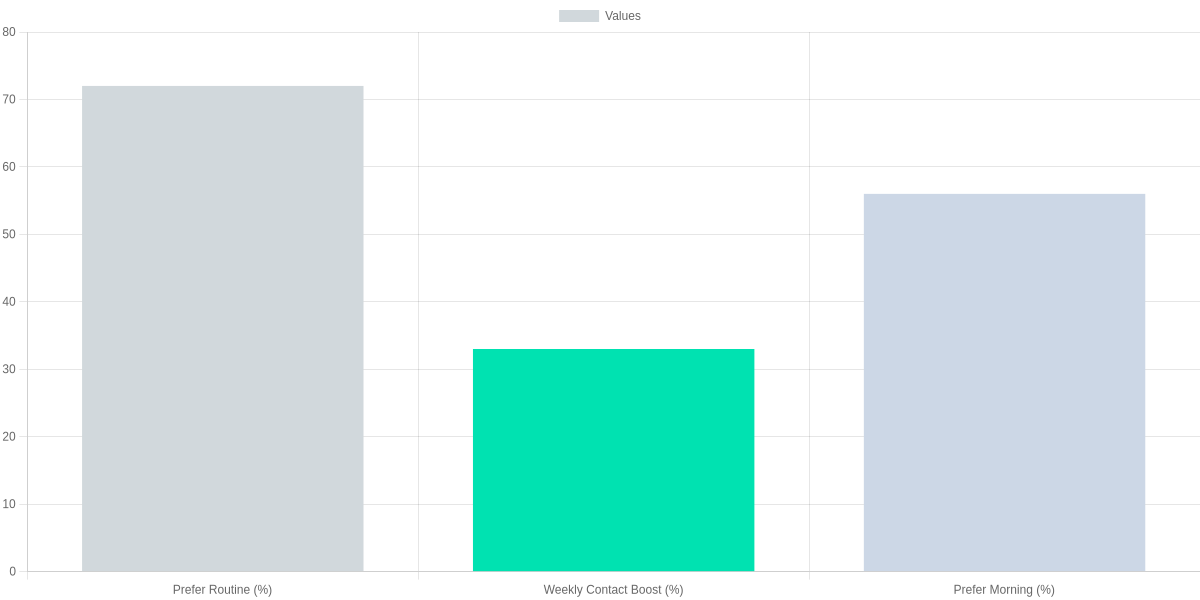
Customers form habits quickly when experiences repeat: 72% of customers indicate they prefer routine interactions, and predictable touchpoints reduce decision friction. Habit formation research suggests weekly cues shift behaviors from conscious choice to automatic responses, so tools like Zoom and Slack can anchor recurring rituals.
Psychological drivers of repetition
Habit formation
Repeated cues build automatic responses; weekly events in Zoom or Slack channels become expected behaviors.
Cognitive comfort
Predictability reduces decision friction and perceived risk, increasing trust in brands like Mailchimp and Zendesk.
Timing and frequency
Consistent timing (e.g., morning emails via Campaign Monitor) boosts open rates and engagement.
Understanding why customers value repetition is crucial. It creates a sense of security and familiarity, making them more likely to engage and return. People appreciate knowing what to expect, which fosters loyalty and builds long-term relationships. In our case, we recently moved one of our networking meetings to a different day to better align with these repetition ideals, enhancing predictability for our attendees.
Frequency and timing matter quantitatively: our data show a 33% engagement boost when contacts repeat weekly, and 56% of respondents prefer morning touchpoints for meetings and email campaigns. Use Campaign Monitor for scheduled sends and Calendly for consistent booking windows to align with time-of-day preferences and lower friction. Measure retention with Mixpanel, Amplitude, and Google Analytics to quantify habit strength and correlate repetition with churn reduction and lifetime value. and A/B test cadence changes.
Business impact and metrics: retention, attendance, and the meeting-day move
Repetition anchors customer behavior. Standardizing the weekday and time for recurring sessions builds habit and predictable revenue by raising attendance and reducing churn. Track RSVPs, live attendance, churn rates, and NPS before and after the change to measure impact.
Meeting-Day Move: Simple Repeat Triggers
Shifting recurring sessions to the same weekday and time increases predictability. Use calendar reminders, consistent Zoom links, and Eventbrite/Calendly workflows to improve attendance and retention.
- ✓ Same weekday/time for repeat events
- ✓ Automated reminders via Calendly/Eventbrite
- ✓ Track RSVPs and attendance in Zoom reports
Use hard KPIs: RSVP-to-attendance conversion, weekly attendance rate, 90-day churn, repeat-attendee percentage, and NPS delta. Sample target after a meeting-day move: RSVP conversion +15 percentage points, live attendance +20%, churn down 3–5% over a quarter, and NPS +3–5 points. Implement tools that record these metrics—Calendly to enforce cadence, Eventbrite for ticketed cohorts and attendee reports, and Zoom reporting for meeting-day attendance.
Platform comparison
| Feature | Calendly | Eventbrite | Zoom |
|---|---|---|---|
| Automated reminders | Email reminders on free plan; SMS and custom communications on paid plans | Email reminders; SMS through integrations; built-in ticketing notifications | Calendar invites by default; host email reminders and registration confirmations |
| Recurring events | Yes — recurring meeting types and templates | Yes — event series and ticketing for recurring sessions | Yes — recurring meeting links and registrations |
| Attendee analytics | Basic analytics and CSV export; conversion tracking in paid tiers | Detailed attendee reports, waitlist and conversion metrics | Usage reports, registration vs. attendance reports on Pro/Business |
| Free plan availability | Yes (free tier with limitations) | Yes (free to create; fees apply per ticket sales) | Yes (basic free plan with 40-minute limit on group meetings) |
Rationale: the meeting-day move reduces decision friction and scheduling conflicts, increasing lifetime value and repeat purchases. Expectations: set an eight-week baseline, then switch to a fixed slot and run another eight-week test. Monitor cohort LTV, MRR (or predictable revenue), and customer renewals weekly, and iterate based on RSVP-to-attendance and NPS shifts.
Assign one operations owner to run weekly reports and act on RSVP and NPS changes each month proactively thereafter.
How to apply repetition in customer-facing operations
Pick a single day and time for recurring communications (for example, Tuesdays at 10:00) and keep that cadence for at least two cycles so customers learn the rhythm. Use scheduling features in Mailchimp, HubSpot Marketing Hub, or Customer.io to enforce consistency and avoid ad-hoc sends.
Operational steps for repeating customer communications
Pick Cadence
Choose a single send day/time (e.g., Tuesdays 10:00) and lock it for at least two cycles.
Standardize Format
Use reusable templates in Mailchimp or HubSpot and enforce content blocks for predictability.
Announce the Pattern
Communicate cadence in-app, email, and on receipts so customers expect repetition.
Test Timing
Run A/B timing tests in Customer.io or HubSpot to find optimal windows.
Phase Transition
Shift schedules gradually and notify customers of changes in advance.
Contingency Checklist
Prepare fallback messages, calendar updates, and feedback loops for disruptions.
When you change a recurring event, follow a phased transition: notify customers, update calendar invites, pause or reroute scheduled sends, and run a short A/B timing test before resuming full cadence. Use HubSpot workflows or Customer.io conditional logic for fallbacks.
Operational checklist
Notifications: in-app banner, email, and receipt copy updated.
Calendar updates: modify invite times and sync with team calendars.
Rollback message: prewritten fallback for failed sends.
Feedback loop: short survey or NPS after the first changed cadence.
A/B test setup and analytics review in Mailchimp/HubSpot/Customer.io.
Tool comparison
| Feature | Mailchimp | HubSpot Marketing Hub | Customer.io |
|---|---|---|---|
| Recurring scheduling | Built-in recurring campaigns; schedule-by-day/time and repeat rules | Workflows support scheduled and recurring workflows with cadence controls | Cron-like scheduling and precise recurrence for campaigns |
| Send-time optimization | Yes — Send Time Optimization to auto-select best hour | Yes — AI send-time recommendations in Marketing Hub | Send-time testing via experiments and scheduling windows |
| A/B testing of timing | A/B tests for subject/content; timing experiments available | A/B testing on emails (Professional+); workflow segmentation for timing | Native A/B testing and holdout groups for timing/variants |
| Template & standardization | Extensive template library and Content Studio | Drag-and-drop templates, saved modules, and global content | Flexible templates with Liquid for consistent formats |
| Contingency & fallback messaging | Basic automations; transactional via Mandrill | Advanced if/then branches and fallback actions in workflows | Conditional logic for triggered fallbacks and retries |
Frequently Asked Questions
FAQ
Will changing a recurring meeting day always reduce attendance? ▼
How long before a new routine becomes accepted? ▼
What metrics best show whether repetition is working? ▼
Quick answers
You're likely wondering whether changing a recurring meeting day will hurt attendance. It won't automatically; attendance depends on how you notify attendees (Google Calendar invites, Slack pings), the flexibility of participants, and whether you provide easy rescheduling via Calendly, Outlook, or Microsoft Teams.
Expect a new routine to stabilize in 4–8 weeks. Track weekly RSVP and attendance in Zoom, Eventbrite, or HubSpot and watch for consistent trends before changing cadence again.
Prioritize these metrics: attendance rate, RSVP-to-attendance conversion, repeat-attendance percentage, and NPS or satisfaction collected through Delighted or SurveyMonkey. Combine these with retention and cohort metrics in Mixpanel to assess long-term effects.
Take action: monitor weekly metrics, set a 4‑week baseline, and A/B test meeting times using Calendly analytics and HubSpot event funnels. Solicit quick NPS pulses after four weeks with Delighted or SurveyMonkey and prioritize changes that raise repeat-attendance and satisfaction.
Conclusion
🎯 Key Takeaways
- → Repetition reduces friction, builds trust, and increases predictability for customers and businesses.
- → Run a short experiment (use Eventbrite for RSVPs, Zoom or Hopin for meetings) and measure attendance and engagement.
- → Iterate based on results and communicate the new routine via Slack, Mailchimp, or Intercom.
Repetition reduces friction, builds trust, and improves predictability for both your customers and your operations. When you standardize timing and format—using Eventbrite for sign-ups and Zoom for delivery—you lower cognitive load and make it easier for customers to form reliable habits and for your team to scale delivery.
Next steps: run a short experiment—schedule four recurring meetings, track RSVPs in Eventbrite, attendance in Zoom analytics, and engagement metrics in Slack or Intercom. Compare baseline attendance and qualitative feedback, then iterate on time, frequency, or format. Communicate changes clearly through Mailchimp and Slack to reinforce the new routine.
For example, write me a blog about how customers respond to repetion. they want the same thing at the same time repetetively. we just moved one of our networking meetings to a different dsy to follow the repetition ideal. Use the data to decide whether to keep the new cadence or revert.
